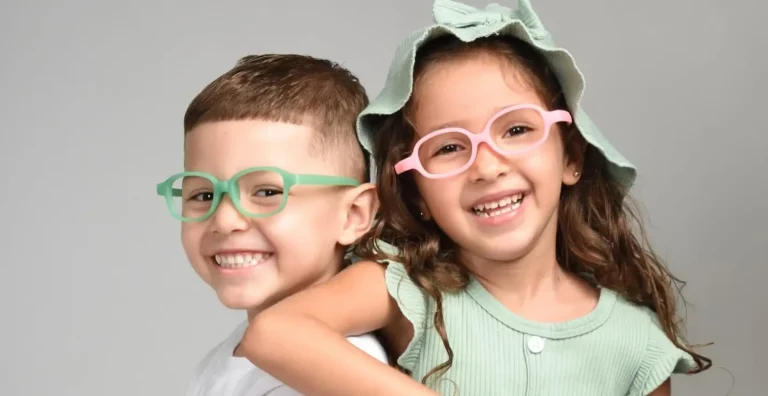


One of the questions I hear from parents more often than almost anything else is why their child’s glasses keep sliding down their nose. Sometimes they’ve bought a second pair thinking the first one was poorly made. Sometimes they’ve returned perfectly good frames because they assumed something was defective. In reality, glasses that constantly slip usually aren’t a manufacturing problem. More often, they’re a fitting problem, a growth problem or simply the result of choosing a frame designed for a different face.
Children’s faces change remarkably quickly. A pair of glasses that fits perfectly in September may begin sliding by Christmas, even though nothing appears different. Adults don’t usually experience changes this rapidly, which is why many parents are surprised when children’s eyewear suddenly becomes uncomfortable after only a few months.
I’ve also noticed that many people expect glasses to behave like helmets. They assume that once they’re on, they should stay exactly where they were placed all day. That’s rarely how eyewear works, especially for children who spend their days running, jumping, looking down at books, climbing playground equipment and constantly moving.
The Nose Doesn’t Always Support the Frame
Adults often have a more developed nasal bridge that naturally helps support eyeglasses. Young children frequently don’t. Many kids have relatively flat nose bridges until they become older. Without that natural support, gravity gradually pulls the frame downward.
Frames that are slightly too wide have nowhere to anchor themselves. Every movement allows them to drift downward a little further. When the frame width matches the child’s face properly, those constant adjustments almost disappear.
Higher prescriptions usually require thicker lenses. Thicker lenses weigh more. More weight shifts the centre of gravity forward, making it harder for the bridge and temples to keep everything stable. Modern lens materials such as polycarbonate and Trivex reduce overall weight while remaining impact resistant.
Children rarely sit still. Reading, writing, climbing, running and playing all change how gravity acts on a frame. School days often reveal fitting problems that never appear at home because children are constantly changing position.
One thing I’ve learned over the years is that parents often assume slipping glasses mean it’s time for a completely new pair. Surprisingly often, that’s not the case. Children’s frames can usually be adjusted several times throughout the year as they grow.
Spring hinges don’t stop glasses from slipping directly, but they help maintain the overall fit much longer by allowing controlled movement instead of placing all the stress on a rigid joint.
Many people associate adjustable nose pads with adult frames, yet they can be extremely useful for children with flatter nose bridges by distributing weight more evenly across the face.
I’ve seen plenty of children wearing perfectly accurate prescriptions inside frames that simply no longer matched their faces. The glasses hadn’t become too old. The child had simply grown.
Parents Sometimes Focus on the Wrong Solution
When glasses start slipping, many parents immediately tighten everything they can. In practice, that often creates discomfort instead of solving the underlying issue. I’ve stopped looking for children’s glasses that never move. They don’t really exist. Instead, I look for frames that remain comfortable throughout a full school day, require only occasional adjustments and continue working reliably as children grow.